This is default featured slide 1 title

Go to Blogger edit html and find these sentences.Now replace these sentences with your own descriptions.

This is default featured slide 2 title

Go to Blogger edit html and find these sentences.Now replace these sentences with your own descriptions.

This is default featured slide 3 title

Go to Blogger edit html and find these sentences.Now replace these sentences with your own descriptions.

This is default featured slide 4 title

Go to Blogger edit html and find these sentences.Now replace these sentences with your own descriptions.

This is default featured slide 5 title

Go to Blogger edit html and find these sentences.Now replace these sentences with your own descriptions.

marți, 22 mai 2012

Hotmail


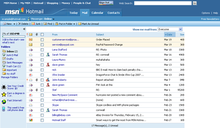
Windows Live Hotmail.pngHotmail (officially Microsoft Hotmail, previously Windows Live Hotmail and MSN Hotmail) is a free web-based email service operated by Microsoft as part of Windows Live. One of the first web-based email services,it was founded by Sabeer Bhatia and Jack Smith and launched in July 1996 as "HoTMaiL". It was acquired by Microsoft in 1997 for an estimated $400 million, and shortly after, it was rebranded as "MSN Hotmail". The current version was released in 2011.
Hotmail features unlimited storage, Ajax, and integration with Microsoft's instant messaging (Windows Live Messenger), calendar (Hotmail Calendar), file hosting service (SkyDrive), and contacts platform. According to comScore(August 2010), Windows Live Hotmail is the world's largest web-based email service with 364 million members, followed by Gmail and Yahoo! Mail, respectively. It is available in 36 different languages.
Hotmail is developed from Mountain View, California. When Hotmail Corporation was an independent company, its headquarters was in Sunnyvale.

Features

Similar to other major webmail services, Hotmail uses Ajax programming techniques and supports later versions of Internet Explorer, Firefox, Safari, and Google Chrome. Some of its features include keyboard controls giving the ability to navigate around the page without using the mouse, the ability to search the user's messages including structured query syntax such as "from:ebay", message filters, folder-based organization of messages, auto-completion of contact addresses when composing, contact grouping, importing and exporting of contacts as CSV files, rich text formatting, rich text signatures, spam filtering and virus scanning, support for multiple addresses, and different language versions.
In comparison to other webmail services, Hotmail offers the following unique features.
Active view
Hotmail's Active view allows users to interact directly with contents and functionalities within their email message. For example, any photo attachments can be previewed directly using Active view. In addition, Hotmail provides a partner platform which allows contents and functionalities from various websites and services such as YouTube, Flickr, LinkedIn, and United States Postal Service to be viewed directly within the email message. For example, users may view the YouTube video within Hotmail when a user receives an email which contains a link to the video. Other functionalities of Active view include tracking of real time shipping status from United States Postal Service and performing social networking actions on LinkedIn directly from within the email message.
Office Web Apps integration
Hotmail integrates with Office Web Apps to allow high fidelity viewing and editing of Microsoft Office Word, Excel, and PowerPoint documents that are attached to the email messages. Users can directly open attached Office documents within the web browser, and save them into theirWindows Live SkyDrive. Users can also perform edits to any received Office documents, and directly reply to the sender with the edited version of the document. In addition, users may also send up to 10 GB of Office documents (up to 50 MB each) using Hotmail by uploading these documents onto Windows Live SkyDrive, and share these documents with other users for viewing or collaboration.
Conversation threading
Hotmail provides the ability to automatically group sent and received emails that are from the same conversation into the same conversation thread, allowing users to quickly browse through all the emails within the same conversation thread. This feature can be turned on or off depending on the user's preferences.
Sweep
Hotmail offers a "virtual broom" which allow users to delete or move large amounts emails into specified folders based on the sender's information. Once a "sweep" is performed, the user may choose to configure Hotmail to remember the sweep settings and perform the same move or delete actions for any future emails. Users may also set up custom message rules based on the sender's or recipient's information, the subject of the email, or attachments to the email. There is also an option to delete/move messages that are older than a specified amount of days, or only keep the latest message from a sender.

Quick views and one-click filters

Quick views allow users to filter all emails (in all folders) by document attachments, photo attachments, flagged messages, or shipping updates. One-click filters allow users to filter the inbox (or specific folder) based on whether or not the email message is unread, from the Windows Live Contacts list, from group mailing lists or Windows Live Groups, or from a social networking website. Categories appear under Quick views for ease of access.

Aliases

Users can create Hotmail aliases for their Windows Live ID. Once an alias is set up, users can choose to have all email sent to that address go to a specific folder, or to the inbox. Users can send emails from that alias as if it is a normal email address. Up to 5 aliases can be made every year, and up to 15 in total. Aliases are completely different to the user's original addresses, and can be removed/created at any time. Aliases are not actual Windows Live IDs, so users can not sign in with them.

Categories

Categories allow users to label messages or senders into a particular group, and those categories will appear under "Quick views" in the sidebar. Some categories are created by default, and some mail is put in those categories by default (e.g. photos, office docs and newsletters). Users can select multiple categories for each piece of mail, have categories applied automatically, and create new ones.

Instant actions

Instant actions are buttons that appear when a user hovers the mouse over a message. Examples of instant actions are delete, move, sweep, and flag, and they are customizable in options.

Registration

Upon registration, new users can choose from a Hotmail domain address (e.g. @hotmail.com and @live.com).

Single-use code

A single-use code is a code you can use instead of your password when you sign in with your Windows Live ID. Each code can be used only one time, but you can request one whenever you need it. If a user is signing in on a public computer—like at the library or school—using a single-use code helps keep your account information secure. Single use code is sent to the user when requested during login.

Hotmail Plus

Comparison of features in Hotmail versions
FeatureHotmail (free version)Hotmail Plus (paid)
Initial email storage capacity5 GB (growing automatically)10 GB (growing automatically)
Email attachment limit25 MB25 MB
Account expiryAfter 270 days inactivityWhen subscription expires
POP3 supportAvailable
IMAP supportUnavailable
SMTP supportPartial
DeltaSync supportAvailable
Microsoft Exchange supportAvailable
AdsPresentAbsent
Notes
A. ^ 10 GB with SkyDrive
B. ^ IMAP support is available via IzyMail
Mail client access

POP3

POP3 access is available for all Hotmail accounts as part of the "Wave 3" release, adding support to access Hotmail from any email client — most notably mobile devices.

WebDAV

WebDAV, which was primarily used by Outlook Express, was discontinued to all users September 1, 2009.

DeltaSync

For access through Microsoft Outlook 2003, 2007, or 2010, users can download the free Microsoft Outlook Hotmail Connector. Using the Outlook connector, users can freely access email messages, contacts, and calendars in any Hotmail account, though access to tasks and notes requires a premium subscription. Another alternative for users is to use the Windows Live Mail desktop client, which has built-in support for Hotmail.[17] Both applications, Windows Live Mail and Microsoft Outlook, can access Hotmail through the proprietary DeltaSync protocol. Currently, no Mac alternative utilizing DeltaSync exists, as Microsoft Entourage does not support it. There has been no word from Microsoft Entourage or Windows Live Hotmail as to whether an "Entourage Connector" will be available in the future.

Exchange ActiveSync

As part of the Hotmail "Wave 4" release, Microsoft has added Exchange ActiveSync support to Hotmail, allowing users to synchronise their email, contacts, and calendar on any device that supports the Exchange ActiveSync protocol.

Android

Push email, contacts, and calendar is available for Android users by an Android app developed by Microsoft.

Spam policy and filtering

Like many free Webmail services, Hotmail is often used by spammers for illicit purposes such as junk or chain mailing and unwanted marketing, due to wide availability, service popularity, and ease of registration of new accounts. However, Hotmail does not tolerate this practice. It subscribes to Microsoft's service agreement, which states any account engaging in these activities will be terminated without warning.

History

Launch of Hotmail

Hotmail service was founded by Sabeer Bhatia and Jack Smith, and was one of the first webmail services on the Internet along with Four11's RocketMail (later Yahoo! Mail). It was commercially launched on July 4, 1996, American Independence Day, symbolizing "freedom" from ISP-based email and the ability to access a user's inbox from anywhere in the world. The name "Hotmail" was chosen out of many possibilities ending in "-mail" as it included the letters HTML – the markup language used to create web pages (to emphasize this, the original type casing was "HoTMaiL"). The limit for free storage was 2 MB.Hotmail was initially backed by venture capital firm Draper Fisher Jurvetson. By December 1997, it reported more than 8.5 million subscribers.Hotmail initially ran under Solaris for mail services and Apache on FreeBSD for web services before being converted to Microsoft products.
MSN Hotmail
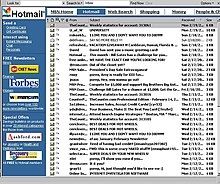
Hotmail was sold to Microsoft in December 1997 for a reported $400 million, and it joined the MSN group of services.[26] Hotmail quickly gained in popularity as it was localized for different markets around the globe and became the world's largest webmail service, and reported more than 30 million active members by February 1999.[27] Hotmail originally ran on a mixture of FreeBSD and Solaris operating systems. A project was started to move Hotmail to Windows 2000. In June 2001, Microsoft claimed this had been completed; a few days later they retracted and admitted that the DNS functions of the Hotmail system were still reliant on FreeBSD. Later development saw the service tied with Microsoft's web authentication scheme, Microsoft Passport (now Windows Live ID), and integration with Microsoft's instant messaging and social networking programs, MSN Messenger and MSN Spaces (now Windows Live Messenger and Windows Live Spaces, respectively).
Security Issues
A security issue appeared in Hotmail during this period that permitted anybody to log into any Hotmail account using the password 'eh'; it was at the time called "the most widespread security incident in the history of the Web."
In 2001, the Hotmail service was compromised again by computer hackers who discovered that anyone could log into their Hotmail account and then cull messages from any other Hotmail account by crafting a URL with the second account's username and a valid message number. It was such a simple attack that by the time the patch was made, dozens of newspapers and hundreds of web sites published exact descriptions allowing tens-of-thousands of hackers to run rampant across Hotmail. The exploitable vulnerability exposed millions of accounts to tampering between August 7, 2001 and August 31, 2001.The space increased to 50MB and then 250MB in 2004.
Competition
After a period of technological stagnation, the webmail industry received a significant boost in 2004 when Google announced its own mail service, Gmail. Featuring greater storage space, speed, and interface flexibility, this new competitor spurred a wave of innovation in webmail. The main industry heavyweights – Hotmail and Yahoo! Mail – introduced upgraded versions of their email services with greater speed, security, and advanced features.
Windows Live Hotmail
Microsoft's new email system was announced on November 1, 2005, under the codename "Kahuna", and a beta version was released to a few thousand testers. Other webmail enthusiasts also wanting to try the beta version could request an invitation granting access. The new service was built from scratch and emphasized three main concepts of being "faster, simpler, and safer". New versions of the beta service were rolled out over the development period, and by the end of 2006 the number of beta testers had reached the millions.
The Hotmail brand was planned to be phased-out when Microsoft announced that the new mail system would be called Windows Live Mail, but the developers soon backtracked after beta-testers were confused with the name change and preferred the already well-known Hotmail name, and decided on Windows Live Hotmail. After a period of beta testing, it was officially released to new and existing users in the Netherlands on November 9, 2006, as a pilot market. Development of the beta was finished in April 2007, Windows Live Hotmail was released to new registrations on May 7, 2007, as the 260 million MSN Hotmail accounts worldwide gained access to the new system. The old MSN Hotmail interface was accessible only by users who registered before the Windows Live Hotmail release date and had not chosen to update to the new service. The roll-out to all existing users was completed in October 2007.
Windows Live Hotmail was awarded PC Magazine's Editor's Choice Award in February 2007, March 2007,and February 2011
It was announced in 2008 on the Windows Live Hotmail website that the service would be updated with focus on improving the speed, increasing the storage space, better user experience, and usability features. It was announced that sign-in and email access speeds will be up to 70 percent faster. The classic and full versions of Windows Live Hotmail are combined in the new release. As a result of user feedback, Hotmail has been updated so that scrolling works for users who have the reading pane turned off. It is also expected that Hotmail team will be moving the advertisement from the top of page to the side, adding more themes, increasing the number of messages on each page, and adding the ability to send instant messages from the user's inbox in future releases.
Support for Firefox in the upgraded Windows Live Hotmail took a few months to complete. Full version support for Google Chrome was also added on November 4, 2008. On October 30, 2008, some account holders using various Linux based browsers started experiencing read-only access. However, with the use of a user agent switcher to dupe Hotmail into thinking the user is accessing from Windows, normal functionality is restored, which indicates that Windows Live Hotmail is only allowing certain browsers at the moment.
As part of the update, Microsoft also added integrated capability for instant messaging with contacts on the Windows Live Messenger service. The feature is the realization of a project that began as "Windows Live Web Messenger" in 2007, a replacement for the outdated "MSN Web Messenger" service that was first launched in August 2004. It was noted that the original "Windows Live Web Messenger" featured tabbed conversations in a "conversation workspace", however since its integration with Hotmail this has been removed.
On May 18, 2010, Microsoft unveiled the "Wave 4" update of Hotmail, which offers features such as 1-click filters, active views, inbox sweeping, and 10 GB space for photos, Microsoft Office documents, and attachments.It also includes integration with Windows Live SkyDrive and Windows Live Office, a free version of Microsoft's Office Web Apps suite. The new version began its gradual release to all Hotmail users on June 15, 2010and was completely rolled out on August 3, 2010. Exchange ActiveSync support was enabled to all Hotmail users on August 30, 2010, allowing users to sync their mail, contacts, calendar and tasks to their mobile devices that supports the protocol. Addition of full-session SSL was released on November 9, 2010.
Throughout 2011, Microsoft added several new features to Hotmail, such as aliasesand speed improvements.In October 2011, Microsoft unveiled a "re-invented Hotmail", and added many new features such as Instant Actions, scheduled Sweep, and Categories and this update began fully rolling out on November 9, 2011. This update also made SSL enabled by default on all accounts.

vineri, 18 mai 2012

Google+

Google+ homepageGoogle+ (pronounced and sometimes written as Google Plus, sometimes abbreviated as G+) is a social networking and identity service, operated by Google Inc.

Introduction

The service was launched as an invitation-only "field test".Early invites were soon suspended due to an "insane demand" for new accounts. On September 20, 2011, Google+ was opened to everyone 18 years of age or older without the need for an invitation. It was opened for a younger age group (13+ years old in US and most countries, 14+ in South Korea and Spain, 16+ in Netherlands) on January 26, 2012.
Google+ integrates social services such as Google Profiles, and introduces new services identified as Circles, Hangouts and Sparks.Google+ is available as a website and on mobile devices. Sources such as The New York Times have declared it Google's biggest attempt to rival the social network Facebook,[10] which has over 800 million users. Google+ is considered the company's fourth foray into social networking, following Google Buzz (launched 2010, retired in 2011), Google Friend Connect (launched 2008, to be retired by March 2012) and orkut (launched in 2004, now operated entirely by subsidiary Google Brazil).
In November 2011, Google+ was integrated into the account creation process for other Google services, such as Google Mail. According to independent analysis of its growth in December 2011, the site was adding an estimated number of 625,000 new users a day, which may total 400 million members by the end of 2012.The site's popularity accelerated in December 2011, with almost a quarter of its total user base joining in December alone, said Paul B. Allen, the founder of Ancestry.com, who tracks the numbers as the "unofficial statistician" for Google+.  However, on February 28, 2012 Todd Wasserman from Mashable reported Google+ users are only spending 3.3 minutes monthly on Google+ which is a downward trend from 4.8 minutes in December and 5.1 minutes in November compared to Facebook users currently spending 7.5 hours using Facebook monthly.

History

The service was launched on June 28, 2011, in an invitation-only "field testing" phase.The following day, existing users were allowed to invite friends who were over 18 years of age to the service to create their own accounts. This was suspended the next day due to an "insane demand" for accounts.
On July 14, 2011, Google announced that Google+ had reached 10 million users just two weeks after the launch of a "limited" trial phase. After four weeks in operation, it had reached 25 million unique visitors. Based on ComScore, the biggest market was the United States followed by India. In October 2011, the service reached 40 million users, according to Larry Page; by the end of the year Google+ had 90 million users.
On August 6, each Google+ member had 150 invitations to give out, but on September 20, 2011, Google+ was opened to everyone 18 years of age or older without the need for an invitation.After Google+ went public, users registered to Google+, but those under 18 years of age were unable to sign up for Google+.
At the initial launch, Google Apps accounts could not be used on Google+ due to lack of support for Google Profiles. On October 27, Google announced that Google+ now supports Google Apps users (if the user's domain administrator has enabled the service).
Despite experiencing high growth in the U.S and European markets, Google+ still remains unavailable in mainland China. While it is not technically "blocked" it was made impossible to use by slowing it down to a crawl.
In under a day, the Google+ iPhone app became the most popular free application in the Apple app store.
Early adopters of Google+ have been mostly male (71.24%). The dominant age bracket (35%) is between 25 and 34.
A survey estimates 13% of U.S. adults have joined Google+; it is projected to have 22% of U.S. adults in a year.
On November 7, 2011, Google launched Google+ Pages, which will let businesses connect with fans in a manner similar to Facebook Pages. These businesses will receive corporate accounts to start sharing information about themselves and invite others to join in on the conversation.
On January 26, 2012, Google opened Google+ to teenagers. The age limit had previously been 18, but Google Vice President for Product Management Bradley Horowitz announced on Google+ that users could now be as young as 13.
According to Experian Hitwise, an Internet metrics firm, the number of U.S. visits to Google+ surpassed 49 million during the one-month period ending Dec. 11, 2011, a 55% increase from the one-month period ending November 11, 2011.

Features


Google staff starting to set up for the President's first Google+ Hangout in the Roosevelt Room of the West Wing. Aired live on the White House Google+ page on January 30, 2012.

President Obama answered questions about the State of the Union posed by citizens in the first-ever completely virtual interview from the White House. Aired live on the official White House Google+ page on January 30, 2012 at 5.30 pm.
  • In the "Stream," which occupies the middle of three columns on the page, users see updates from those in their Circles. There is an input box which allows users to enter a post. Along with the text entry field there are icons to upload and share photos and videos. The Stream can be filtered to show only posts from specific Circles.
  • "Circles" enable users to organize people into groups for sharingacross various Google products and services. Although other users may be able to view a list of people in a user's collection of Circles, they cannot view the names of those Circles. The privacy settings also allow users to hide the users in their Circles as well as who has them in their Circle. Organization is done through a drag-and-drop interface. This system replaces the typical friends list function used by sites such as Facebook. Since September 26, 2011 users can share Circles; it's a one-time share, so if the creator of the Circle updates the members, people's shared copies won't be updated.
Another function of Circles is to control the content of one's Stream. A user may click on a Circle on the left side of the page and the Stream portion of the page (the center) will contain only posts shared by users in that Circle. For the unsegmented Stream (includes content from all of a user's Circles), each Circle has a "slider" configuration item with four positions: nothing, some things, most things, and everything. The nothing position requires the user to select (click on) the Circle name explicitly to see content from users in that Circle. The everything setting as its name implies filters nothing out from people in that Circle. The remaining two positions control the quantity of posts which appear in one's main Stream, but the algorithm controlling what shows has not been disclosed.
The default "Circles" are Friends, Family, Acquaintances, and Following. Users cannot change anything but the content slider and membership about these Circles (for example, they cannot be renamed or deleted).
The "Following" Circle is described by Google+ as "People you don't know personally, but whose posts you find interesting."
"Hangouts" are places used to facilitate group video chat (with a maximum of 10 people participating in a single Hangout at any point in time). However, anyone on the web could potentially join the "Hangout" if they happen to possess the unique URL of the Hangout.On August 18, 2011 Google added a new addition to "Hangouts" - clicking on the Share button under any YouTube video reveals an icon that suggests watching the video with friends in a Google+ hangout.
    • Mobile Hangouts currently supports Android 2.3+ devices with front-facing cameras (and iOS support is coming soon) are available since September 20, 2011.
    • Hangouts On-Air gives users the ability to create instant webcasts over Google+. The broadcasts can also be recorded for later retrieval. This feature, announced on September 20, 2011, is currently limited to some videocast personalities, but the announcement indicates that it will be opened up. The first publicly broadcasted Hangout was with The Black Eyed Peas’ will.i.am on the night of September 21, 2011.The feature became available at a large scale on May 7, 2012.
    • Hangouts with Extras, currently in a preview state, will allow users to share documents, share a scratchpad and share their screens with other users.
  • "Messenger" (formerly: Huddle) is a feature available to Android, iPhone, and SMS devices for communicating through instant messaging within Circles. Additionally, you can now share photos in Messenger between your Circles.
  • "Instant Upload" is specific to mobile devices; it stores photos or videos in a private album for sharing later.
  • "Sparks" is a front-end to Google Search, enabling users to identify topics they might be interested in sharing with others. "Featured interests" sparks are also available, based on topics others globally are finding interesting.Sparks helps to keep users informed of the latest updates on the topics of their interest.
  • "Games" (social gaming) had 16 games when launched on August 11, 2011, which has since been expanded to 44.[citation needed] Unlike Facebook games, Google+ games are located under a games tab, which gives games less visibility, and have notifications that are separate from the rest of a user's notifications.
  • Google+ has a "+1 button" to allow people to recommend sites and parts of sites, similar in use to Facebook's Like button.
    • Google recently announced that since introducing this +1 button, it is now being served more than 5 billion times per day.
    • With the implementation of the +1 button, Google hopes to make search results more "germane". This will not directly affect search rankings.
  • Similar to other Google applications, Google+ provides integration with other Google applications like Gmail, Calendar, Documents, etc.
  • A "Data Liberation" option provides the ability to download one's content from Google+.
  • "Search in Google+" allows users to search for content within Google+. Users type what they're looking for into the Google+ search box, and Google will return relevant people and posts, as well as popular content from around the web.
  • Hashtags, which involve the prepending of a number sign to the beginning of a word or CamelCase, are hyperlinked to the most recent or highest-trending search results within Google+ containing the term. This, a feature which gained notoriety as a microblogging practice on Twitter, was implemented as a Google+ feature on October 12, 2011. Autocompletion came on January 17, 2012.
  • "New Features for Google+ Mobile" Since the launch of Google+, Google has been adding and improving many features. On September 30, 2011, the company released a list of changes and additions to Google+ mobile which include:
    • Improved SMS support so that users in the US and India can now post to Google+, receive notifications, and respond to group messages via SMS. They have also made it easier to +mention someone from a mobile device. Now, to +mention another user, one simply writes +[their name] inside a post or comment. In order to +1 comments more easily, users are now able to +1 them directly from their iOS devices. They also introduced this feature to the Android app in December 2011.
    • Users are now able to edit their profile photos from a mobile device.
    • Google has now made it simple to organize Google+ notifications from a mobile device. This feature allows users to select which notifications are important to them and which are not so that their mobile devices are not inundated with superfluous notifications.
  • "What's hot" Stream, introduced on October 27, 2011, is a stream showing what Google+ users are currently excited about. Initially it appeared in the middle of a user's stream as a separate collapsable section. As of February 2012, it still appears in the middle of one's Stream, but it behaves more like a Circle in that it has a slider control; thus a user may turn it off completely (except for it being listed on the left side of the page) by sliding the slider for it to the nothing position. For some, the appearance of What's Hot in Streams was such an annoying (mis)feature that it was listed as one of Google+'s known issues.
  • Ripples, introduced on October 27, 2011, is a visualisation tool, showing how resharing activity happens regarding a public post. One can replay the public share's activity, zoom in on certain events, identify top contributors, view statistics about average chain length, the most influential people in the chain, the language of the sharers, etc.
  • Google+ Creative Kit is an online photo editor integrated to Google+ on October 27, 2011,which is essentially Picnik, integrated earlier to Picasa Web Albums.
  • Google+ Pages was launched on November 7, 2011 to all users. It allows entities which are not individuals (such as organizations, companies, and publications) to set up profiles, or "pages," for the posting and syndication of posts. It is similar to Facebook's similarly-named feature. At the same time, Google changed the site's logo and favicon, from black to a red one, matching the colour of the coral notification icon.
    • Google+ Badges was quietly rolled out to select enterprises beginning 9 November 2011 and officially released to the public on 16 November. Badges are sidebar widgets which embed "Add to Circles" buttons and drop-down lists into off-site websites and blogs, similar to Facebook's Like Box widgets. This was officially treated by Google as a replacement for the older Google Friend Connect and its widgets, and GFC was announced by Senior Vice President of Operations Urs Hölzle on 23 November 2011, as scheduled to be retired by 12 March 2012 on all non-Blogger sites in favor of Google+ Page Badges.
  • Select public figures have verified names. Google determines whether a particular profile warrants verification. The purpose is to indicate to site visitors whether a particular profile belongs to who one would generally expect the name to be, and not someone who coincidentally has the same name as a public figure. Verified identity profiles have a checkmark logo after their name. Examples of profiles bearing the verified name badge include Linus Torvalds, William Shatner, Leo Laporte, Mark Zuckerberg, Larry Page, and Sergey Brin.

Technologies

According to Joseph Smarr, technical lead on the Google+ team (former Plaxo CTO) Google+ is a typical Google web application: it uses Java servlets for the server code and JavaScript for the browser-side of the UI, largely built with Google's Closure framework, including the JavaScript compiler and the template system. They use the HTML5 History API to maintain good looking URLs in modern browsers despite it being an AJAX app. To achieve fast response times Google often renders the Closure templates on the server-side to render it before any JavaScript is loaded; then the JavaScript finds the right DOM nodes, hooks up event handlers etc. The backends are built mostly on top of BigTable and Colossus/GFS, and other common Google technologies such as MapReduce.

Reception

Design impact

The introduction of Google Plus had an impact on the graphic redesign of Google's web search service. CNN noted the "combo-plate approach" of Google+, likening the new social effort to a "Taco-Bell-meets-KFC." As it was explained later, Google+'s new look is actually part of a broader effort to refresh the visual design across Google, to achieve a consistent experience in all products across the Google spectrum.
In particular, there have been changes to Picasa Web Albums, whereby all Picasa users images will automatically join their Google Plus image storage. Google also plans to rebrand Picasa as Google Photos.Other changes:
  • After tagging someone, they receive a notification and can see the photo and the related album.
  • For new albums, anyone an album is shared with can see who else it is shared with.
  • Albums someone shared can be tagged and re-shared by others.
  • Photos up to 2048×2048 pixels and videos up to 15 minutes won't count towards the 1 GB storage quota for Google+ users (it is 800×800 pixels for non-Google+ users), creating "virtually unlimited" storage for mobile users.
Google Maps got the redesign on June 28, 2011.A redesigned Gmail and Calendar interface was first available at July 1, 2011.The Google News redesign went live on July 21, 2011and Google Docs got a new look on August 5, 2011.
The new Google Reader interface was made available on October 31, 2011. Beside the sweeping visual changes, former social features ("share" and "like" buttons) have been replaced by a Google +1 button and the "share on Google+" box. It's said that now Reader is on its fourth social model, after using Google Talk contacts, allowing people to manage friends from the Reader interface and then integrating with Google Buzz.
Further design developments related to Google+ occurred in January 2012. On January 10, Google released "Search plus Your World", which inserts content shared on Google+ profiles and brand pages under Web Search results. The feature, which is opt-in, was received with controversy over the emphasis of Google+ profiles over other social networking services' user profiles (i.e., Facebook and Twitter). The feature builds upon the earlier "Social Search" feature which indexes content shared or published by authors; "Social Search", however, relied partly upon returns from non-Google services, such as Twitter and Flickr.

Importing contacts from other social networks

Google+ includes a feature to invite contacts from Yahoo! and Hotmail. At this time, however, there is no official way to import Facebook contacts into Google+; but there are some workarounds to achieve it.Facebook allows users to download their data, but not in a simple format easy to import; network effects make it difficult for a new social network such as Google+ to be successful, and an easy tool to migrate to a rival service would reduce the effect.

Censorship by governments

Within a day of the website's launch, various news agencies reported that Google+ was blocked by the People's Republic of China. This is part of a wider policy of censorship in mainland China. The Iranian government has also blocked access to Google+ from 11 July 2011, as part of Internet censorship in Iran.

"Occupy Obama's G+"

On 20 February, 2012, Internet users from the People's Republic of China realized that state restrictions on Google+ had been relaxed for unknown reasons, allowing them to post on Google+ pages. In particular, Chinese users began to inundate the official election campaign pages of U.S. president Barack Obama on Google+ with often-off-topic comments in simplified Chinese characters.
The "occupation" of Obama's G+ page is largely considered a temporary mistake in Chinese censorship by observers outside of China,as Google reduced its physical presence in mainland China.

Controversies

Joining the service requires mandatory real-name and gender disclosure, which at launch was shared as public information. The gender selector has options for "Male", "Female", and "Other". This requirement was criticized by the weblog SlashGear for causing lack of privacy and, together with Facebook and other social networks, for forcing the user to choose among limited categories that describe preconceived gender descriptors. The mandatory public gender exposure led to criticism for making older Google profiles public. In response, Google made changes to the service that allow users to control the privacy settings of their gender information. Google's justification for requiring gender information is that it uses that information to inform its usage of the terms "he," "she," and "they" in their delivery of information to users of the service. If a user decides to make the gender portion of the profile private, the language used to convey information becomes gender-neutral, using the singular they in place of gender-specific pronouns.
Google+ allows its users to +1 and recommend items across the web to their friends and contacts. However, it offers no control on who sees people's +1s (includes +1s on Google ads and third party sites). Since anyone can add others to their circle without getting confirmed/approved, anyone can potentially see other's +1s . Google displays +1 to a user based on his/her social connections. If a person adds another to their circle, he/she will be added to their social connection. However, Google allows its users to either hide or show +1 tab on their profile and all +1's are manageable from the +1 tab.

Nymwars

Google+ requires some users to identify themselves using their real names and accounts may be suspended when this requirement is not met.Google VP Bradley Horowitz has stated that a violation of the terms of service will only affect the service whose terms were violated and not any of the other services that Google provides. However, there are reports of account holders being temporarily locked out of all of Google services.
On October 19, 2011, at the Web 2.0 Summit, Google executive Vic Gundotra revealed that Google+ will begin supporting pseudonyms and other types of identity within a few months.